E-sourcing and RFP
RFQ or RFP? Choosing the right sourcing event
Choosing the wrong sourcing event wastes everyone's time. Run an RFP for office supplies and suppliers drown in questions that do not matter. Run an RFQ for an engineering project and you compare prices for solutions that are not the same. The choice comes down to one question: do you already know exactly what you need?
RFQ: the need is defined, you want a price
A request for quotation fits when the item, quantity and specification are clear. Suppliers quote on the same thing, so you compare price, delivery time and terms side by side. In Millisave, an RFQ request has three steps: request information, products and services, then review and submit.
Typical uses: consumables, standard parts, catalog items, repeat purchases.
RFP: the need is open, you want a proposal
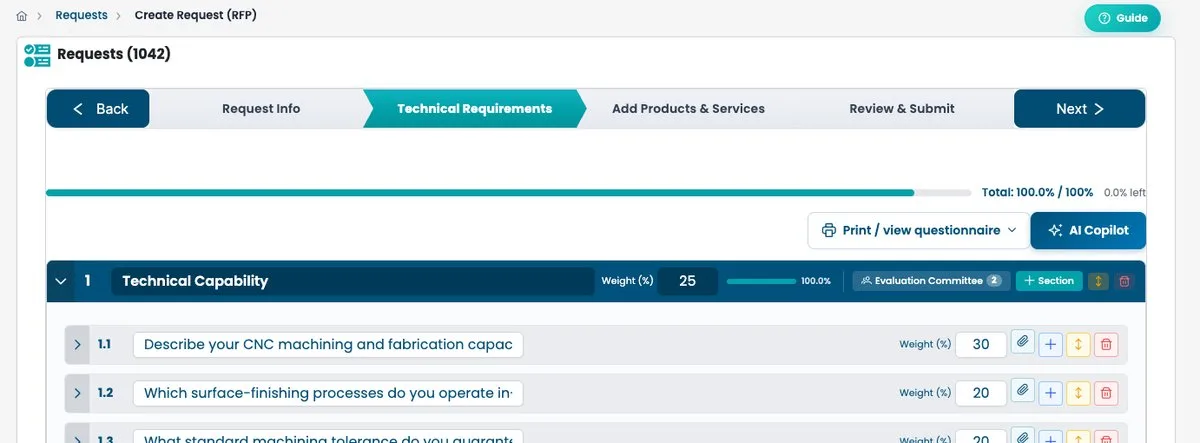
A request for proposal fits when suppliers must explain how they would meet your need: equipment with options, services, projects, anything where capability matters as much as price. The RFP wizard adds a technical requirements step, where you build a weighted questionnaire, and the evaluation then scores suppliers on both technical and commercial criteria.
Typical uses: industrial equipment, maintenance contracts, engineering and installation projects.
What an RFP adds
- A weighted questionnaire organised in sections, with a weight and a maximum score per question.
- An evaluation committee chosen section by section, so technical experts score technical sections.
- AI generation: describe the scope and language, and the AI drafts the questionnaire for you to edit.
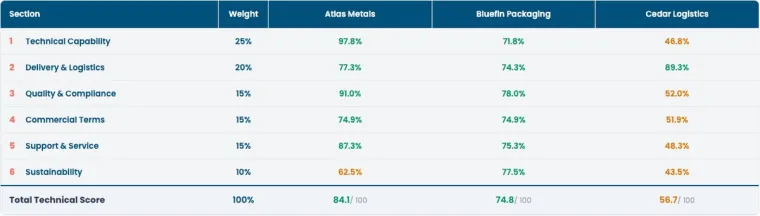
- A scoring summary that ranks suppliers and shows how each score was built.
The six stages of an RFP in Millisave
- Request: the four-step RFP wizard.
- Question: weighted sections and questions, committees, or an AI-generated draft.
- Consult: launch the e-sourcing event from the request.
- Choose suppliers: from your internal suppliers, the marketplace, a one-off spot supplier, or AI Engine Search to find new ones.
- Evaluate: commercial scoring, technical scoring, then the RFP scoring summary.
- Award: accepting an offer creates a draft purchase order.
Quick decision guide
- Can you write the exact specification on one line? Use an RFQ.
- Will suppliers propose different solutions? Use an RFP.
- Is price the only thing that will decide? RFQ.
- Do capability, method, safety or after-sales support matter? RFP.
Start with the lightest event that gives you a fair comparison. You can always move from a quick RFQ to a structured RFP when the answers show the need is less defined than you thought.