E-sourcing and RFP
Weighted RFP scoring: make every award explainable line by line
Every buyer has had to defend an award. Finance asks why the cheapest offer lost. A losing supplier asks what they missed. An auditor asks who decided. If the answer is "the committee preferred them", you have a problem. A well-built RFP gives a different answer: here is the weighting we agreed before opening the offers, and here is how each supplier scored against it.
Decide the weights before you see the offers
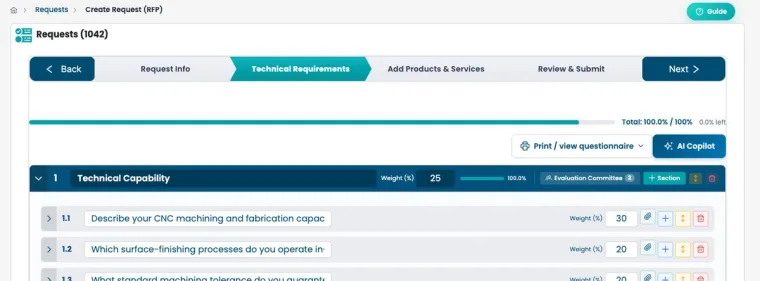
In Millisave, an RFP questionnaire is built in sections, and each section carries a weight. The section weights add up to 100%, and the questions inside each section also add up to 100%. A typical industrial RFP might weight technical solution and compliance at 30%, relevant experience at 15%, team and safety capability at 15%, execution method and schedule at 10%, equipment quality and after-sales at 10%, and the commercial evaluation at 20%.
Fixing these numbers first is the whole point. Once offers arrive, nobody can quietly reshape the criteria around a favourite.
Design questions that can be scored
Each question has an answer type, an evaluation type and a maximum score. Choice questions can carry weighted options, so the score follows from the answer rather than from a mood. Open questions are scored by evaluators against the maximum you set. The rule: if two evaluators could not agree on how to score a question, rewrite it.
Give each section the right judges
Evaluation committees are set section by section, not once for the whole RFP. Your maintenance engineer scores the technical sections, your HSE lead scores safety, and procurement scores the commercial part. Each person judges what they actually know.
Let AI draft, then decide yourself
Two AI features speed up the slow parts. First, the questionnaire can be generated by AI from the scope you describe, in the language you choose, as a draft you then edit and weight. Second, AI Engine Search helps you find suppliers beyond your usual panel, across the markets you select. The principle is simple: AI widens the panel; it does not validate it. Every supplier it finds still goes through the same weighted evaluation as everyone else.
Read the scoring summary
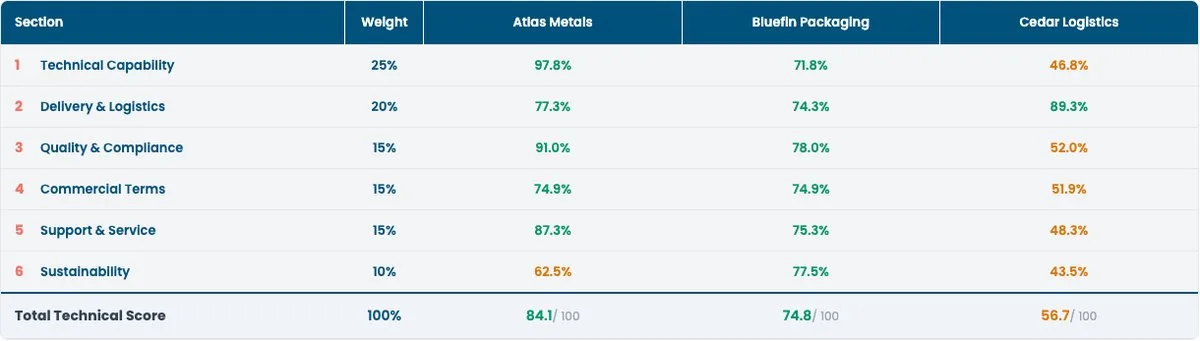
After evaluation, the RFP scoring summary ranks suppliers and breaks every score down by section and question. The final weights between the commercial score and the technical score are set in a dedicated window, so the balance between price and capability is explicit too. When someone asks why a supplier won, you can show the calculation line by line.
Common mistakes to avoid
- Too many sections. Five or six is enough. More sections dilute the ones that matter.
- Price hidden in technical questions. Keep cost in the commercial evaluation, or you count it twice.
- Weights set after opening offers. It defeats the purpose and is the first thing an auditor checks.
- One committee for everything. Use section committees so expertise matches the question.
An RFP done this way is slower to prepare and much faster to defend. That is a trade worth making on every significant award.